
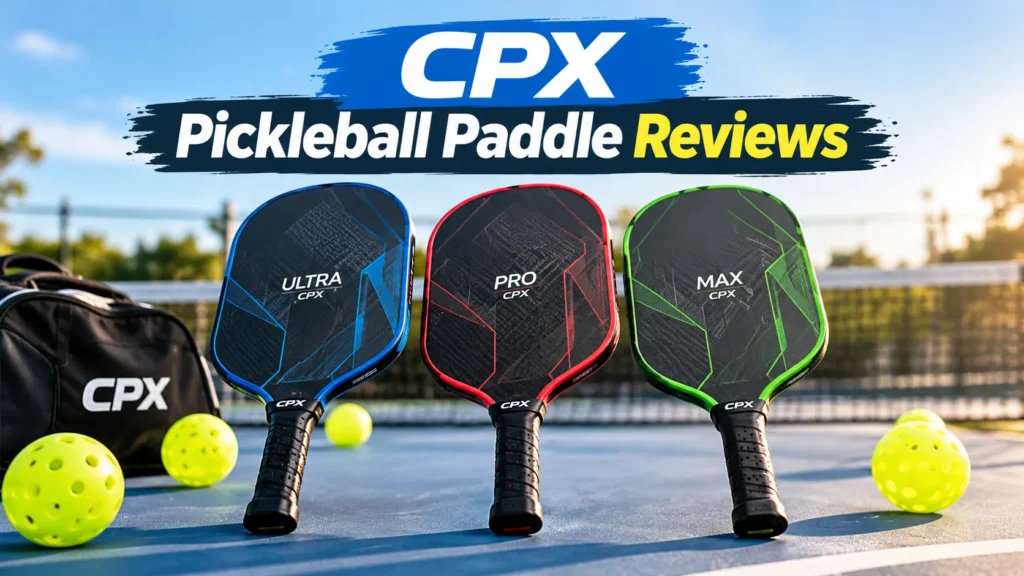
Most players think a paddle is just a piece of composite and carbon fiber, until a single equipment shift instantly tightens their baseline control and unlocks effortless power. Sifting through conflicting cpx pickleball paddle reviews usually leaves competitors more confused than ever, because raw specifications rarely tell the whole story about dwell time, core stability, and torsional twist. Analyzing the engineering blueprints behind the CPX lineup reveals exactly how millimeter shifts in core thickness and surface grit translate into tournament-level performance on the court.
CPX Pickleball Paddle Reviews
Verified specs & prices from the official CPX site (October 2026) · By primary playing style
Comprehensive cpx ultra pickleball paddle review: Technical Anatomy
Any honest cpx ultra pickleball paddle review has to start with the core, because that is where this paddle separates itself from the rest of the lineup. CPX positions the Ultra at the 16mm midpoint between the 19mm Pro and the 14mm Max, and it is the highest-rated paddle the brand sells, at 4.9 stars from more than 900 owners on its official product page.
- The Core Matrix: Instead of one uniform honeycomb running edge to edge, the Ultra places three high-density foam rings around a CPX-specified honeycomb blend. The foam sits toward the perimeter, so the outer face responds closer to the center than on a standard honeycomb paddle.
- The Surface Boundary: The face blends aramid with carbon fiber and adds a textured friction finish on top. Aramid is tougher than carbon alone and damps vibration, which translates into a muted, plush impact feel rather than a sharp, ringing one.
- Frame Construction: Face, walls, and throat are thermoformed as a single unibody piece. Fewer seams means fewer weak points, and the stiff frame keeps the paddle from going soft after months of hard hitting.
- Handle Geometry: An elongated 11.6 x 7.48 inch face pairs with a 4.92 inch handle and a 4.21 inch grip circumference, which leaves room for a two-handed backhand without regripping.
Core Performance on Court
The perimeter foam rings are the real story. By moving mass to the outer edges, they raise the paddle’s twist weight, which is its resistance to rotating in your hand on an off-center strike. A ball caught near the edge loses far less energy to paddle torsion, so it comes off closer to where you aimed instead of dying in the net.
- Dinks and Resets: The 16mm core absorbs enough pace to keep a late, slightly off-center dink low, which removes a lot of the pop-ups that get attacked at the kitchen.
- Drives and Counters: The thermoformed frame adds stiffness, so the Ultra still has enough return to finish a point when a ball sits up. It will not match the Max on raw pace, but it transitions from defense to offense without a paddle swap.
- Spin Generation: The friction finish grips the ball at contact, loading topspin on drives and bite on slice returns. CPX states the texture is tuned to the limit USA Pickleball allows.
Pros
- Genuine All-Court Balance: One paddle handles resets, dinks, speed-ups, and drives without forcing a style choice.
- Forgiving Edges: The three-ring perimeter delivers a reliably large usable face.
- Plush, Quiet Feel: Aramid gives less harsh feedback on contact than a pure carbon face.
- Tournament Ready: USA Pickleball Approved and PBCoR 43 certified out of the box.
Cons
- Narrower Face: At 7.48 inches wide, it is slimmer than a widebody, so blockers who rely on face width should know this before ordering.
- Colorway Price Creep: The Launch Edition costs $199.97, but limited finishes run from $239.97 up to $299.97 with identical performance.
- Short Adjustment Window: Some owners report it feels slightly heavier or bottom-heavy for the first few sessions, especially coming off a lighter paddle.
Best for: intermediate to advanced players who play the whole court and want one paddle that never forces them to choose between a soft game and a fast one.
Comprehensive cpx pro pickleball paddle review: Technical Anatomy
Most players expect a $99.97 paddle to cut corners, which is exactly why this cpx pro pickleball paddle review matters. The Pro is CPX’s best seller and its dedicated control paddle, built around the thickest core the brand makes and a raw carbon face that holds its texture instead of relying on paint.
- The Core Matrix: A 19mm polypropylene honeycomb with 6mm cells. That thickness absorbs incoming pace instead of firing it back, which is the whole mechanical basis of a control paddle.
- The Surface Boundary: A raw 3K carbon fiber face with a matte, textured finish. The 3K weave is slightly more flexible and forgiving than unidirectional carbon, so it feels softer on contact.
- Edge Engineering: Foam-injected walls fill the perimeter where many paddles leave a hollow cavity. This widens the usable hitting area and quiets the paddle on contact.
- Handle Geometry: A standard 15.94 x 7.67 inch shape with a 4.84 inch handle and a 4.1 inch grip circumference, at a static weight of 235 g.
Core Performance on Court
A 19mm core compresses more on impact and returns less energy, so a hard drive arriving at the kitchen line slows down on your face instead of rebounding high. That is why third-shot drops land short and resets stay unattackable. The trade-off is direct: whatever pace you want on offense, you must supply with your own swing speed.
- Kitchen Exchanges: The wide, quiet face and light static weight make blocks and dink rallies feel calm and predictable.
- Drives: Expect a heavier, slower ball off the face. Players who hunt baseline winners will notice the lack of pop immediately.
- Spin: The raw 3K texture shapes dinks and slice returns well, and because it is part of the weave rather than a coating, it holds up longer than painted grit.
Pros
- Elite Touch per Dollar: A 19mm core with foam-injected walls is rare below $100.
- Raw Carbon Texture: Spin comes from the weave itself, not a spray-on layer.
- Accessories Included: Cover, edge tape, and keychain ship in the box.
Cons
- Low Offensive Pop: Passing shots and put-aways demand full swing effort.
- Handle Length Debate: CPX says the 4.84 inch handle fits two hands, but some community players find it short for a committed two-handed backhand.
- Not Thermoformed: It lacks the unibody frame of the Max and Ultra, and at least one owner on the official review page reported perimeter dead spots near the 11-month mark before a warranty replacement.
Best for: dinkers, defensive doubles players, and anyone who loses more points to popped-up resets than to slow drives.
Comprehensive cpx max pickleball paddle review: Technical Anatomy
This cpx max pickleball paddle review covers the opposite end of the CPX dial. The Max is built for players who end points, with the thinnest core in the lineup, an elongated frame, and the Chris Chelios signature colorway that has made it one of the most recognizable paddles CPX sells.
- The Core Matrix: A 14mm polypropylene honeycomb with 6mm cells. Less core between your hand and the ball means less energy absorbed and a faster exit off the face.
- The Surface Boundary: A T700 carbon fiber face, a higher tensile grade than standard 3K, topped with a textured friction finish that grips the ball for spin.
- Frame Construction: A thermoformed unibody with an aerodynamic channel cut into the throat, which trims mass where it does nothing for the hitting surface.
- Handle Geometry: An elongated 16.52 x 7.48 inch shape with a 4.92 inch handle, a 4.21 inch grip, and a listed weight of 8.2 oz.
Core Performance on Court
The Max generates its power through swing weight, not static weight. Because the elongated shape places mass farther from your hand, the paddle resists rotation more and carries more momentum through contact. That is what produces plow-through on serves and drives, and it is also why the Max feels heavier in motion than its 8.2 oz listing suggests.
- Baseline Drives: The thin core returns nearly all of your swing, so drives arrive before opponents finish their split step.
- Reach: The extra length gets a paddle on lobs and wide balls that a standard shape would miss.
- Hand Battles: The same swing weight that powers drives makes the paddle slower to stop and restart in rapid kitchen exchanges.
Pros
- Top-Tier Pace: 14mm thermoformed construction at $159.97 undercuts many premium power paddles.
- Heavy Spin Potential: T700 carbon plus friction finish pulls aggressive drives down inside the baseline.
- Two-Hand Friendly: The 4.92 inch handle suits tennis converts with two-handed backhands.
Cons
- Demanding Soft Game: Drops and dinks sail long until your touch adapts to the thin core.
- Weight Variance: Independent reviewers have measured units closer to 8.47 oz than the listed 8.2 oz.
- Grit and Throat Notes: Some players report a less consistent response near the aerodynamic channel, and one owner on the official page noted the grit wearing smooth within a few months.
Best for: aggressive singles players, tennis converts, and bangers whose soft game is already reliable.
CPX Air Review: Technical Anatomy of the Entry-Level Pick
The Air is the paddle most players overlook, and that is a mistake. For $99.97 it delivers a T700 raw carbon face, a material usually reserved for paddles priced well above $150, along with tournament approval on day one.
- The Core Matrix: A 16mm polymer honeycomb, thick enough to stay stable when you catch the ball off center.
- The Surface Boundary: Raw, textured T700 carbon, where the grip on the ball comes from the weave itself.
- Handle Geometry: A 10.63 x 7.48 inch face and a 5.71 inch handle, one of the longest in the CPX lineup, at 8.4 oz.
- Pros: Quick hands at the net, genuine raw-carbon spin, and the most two-hand room of any paddle in this review.
- Cons: CPX itself states it has less power than the Max or Ultra, and it is not thermoformed.
Best for: players upgrading from a recreational paddle who want real spin without a premium price.
Head to Head: CPX Ultra vs. CPX Pro vs. CPX Max vs. CPX Air
Core thickness is the clearest way to read the CPX lineup. The Pro sits at 19mm for touch, the Ultra and Air sit at 16mm for balance and forgiveness, and the Max sits at 14mm for pace. The matchups below show where each paddle actually wins.
CPX Ultra vs. CPX Max
- Power: The Max wins on raw exit speed thanks to its 14mm core and longer 16.52 inch frame.
- Control: The Ultra wins at the kitchen, where its foam rings and extra 2mm of core settle resets.
- Verdict: CPX calls the Ultra the safer pick and the Max the sharper one, which matches how they play.
CPX Ultra vs. CPX Pro
- Soft Game: The Pro is more forgiving on pure dinks and drops because of its 19mm core.
- Versatility: The Ultra can attack a high ball; the Pro mostly cannot without a full swing.
- Verdict: If almost all of your game happens at the kitchen line, save $100 and take the Pro.
CPX Pro vs. CPX Air
- Same Price, Different Jobs: Both cost $99.97, but the Pro trades speed for touch and the Air trades touch for quickness.
- Face Grade: The Air uses stiffer T700 carbon; the Pro uses softer 3K carbon.
- Verdict: Choose the Pro for control and the Air for fast hands and the longest handle.
How CPX Core and Face Technology Shapes Performance
Every paddle in this review uses a polypropylene honeycomb core, a lattice of hollow hexagonal cells that compress and spring back on impact. Honeycomb gives crisp, predictable feedback, but repeated hard impacts can permanently deform cell walls and create dead spots, a failure known as core crush. CPX’s flagship Hyper+ addresses this with a full-foam Hyperfoam X core, which increases dwell time and spin but requires a recalibration of touch.
- T700 Carbon: A high tensile grade that is stiffer per gram, giving a crisper and more consistent rebound on the Max and Air.
- 3K Carbon: A standard weave of 3,000 filaments per bundle, slightly more flexible and softer, which suits the Pro’s control mission.
- Aramid Blend: Tougher than carbon alone with natural vibration damping, giving the Ultra its quiet, plush feel.
- Thermoforming: Face, core, and frame fused under heat and pressure into one piece, which raises torsional stability and edge stiffness on the Max and Ultra.
These differences matter most in the soft game, where a millimeter of core changes how high a reset bounces. If you are still building that foundation, our guide to pickleball rules and kitchen play explains the non-volley zone mechanics these paddles are designed around, and newer players can start with what pickleball is and how the game works.
What Most CPX Pickleball Paddle Reviews Leave Out
Competitor reviews tend to repeat spec sheets and marketing claims. These are the practical details that actually change a buying decision, and most of them come straight from CPX’s own product pages and owner feedback.
- Spec Sheet Conflicts: CPX’s own page summaries sometimes disagree with its spec tables. The Max summary mentions about 7.8 oz while the spec table lists 8.2 oz, and the Air summary cites 240 g while the spec table lists 8.4 oz. Trust the detailed specification table on each product page.
- Colorways Play Identically: CPX confirms that every Max and Ultra colorway shares the same core, face, and shape. You pay $20 to $100 more purely for finish, metal caps, or an Alcantara suede handle.
- Handle Length Ladder: For two-handed backhands, the order is Air (5.71 in), then Max and Ultra (4.92 in), then Pro (4.84 in). Few reviews line these numbers up side by side.
- Grit Is a Consumable: Even raw and friction-finish faces wear over heavy play. Owner reviews on the official pages mention smooth faces and dead spots that CPX replaced, which makes the warranty more relevant than the face material alone.
- Return Fine Print: The 90-day guarantee refunds in full with no restocking fee, but you pay return shipping, and Mystery Paddle and Pro BOGO orders are final sale. Avoid adding lead tape or swapping grips during the trial if you might return it.
- Hyper vs. Hyper+ Naming: The CPX Hyper is a 16mm honeycomb paddle with a three-layer T700 face, while the Hyper+ uses the full-foam Hyperfoam X core. They are different paddles despite the similar names.
cpx pickleball paddle review: Brand Verdict on Value, Warranty, and Build
A complete cpx pickleball paddle review has to judge the company behind the paddles, not just the paddles themselves. CPX designs its lineup in Chicago and ships from its own warehouse there, with in-stock orders placed before 3 p.m. Central leaving the same business day and typically arriving in one to two business days.
- Manufacturing Reality: Like most premium brands, CPX uses specialized OEM factories in China for carbon layup and thermoforming. Its value comes from proprietary core blends and a direct-to-consumer model that skips distributor and pro shop markups.
- Warranty Structure: Every paddle is covered against manufacturing defects. An optional Lifetime Warranty add-on extends coverage to bumps, scrapes, and normal wear for as long as you own the paddle, and it comes included with Hyper+ pre-orders.
- Tournament Legality: All main CPX models are USA Pickleball Approved for sanctioned amateur events. Professional tours may require separate UPA-A certification, so pro-division players should check before entering.
- Market Positioning: The Ultra competes with control paddles such as the Selkirk LUXX Control Air, which runs roughly $280 with a thicker 20mm core, while the Max targets 14mm elongated thermoformed rivals priced above $200.
Final Verdict: Which CPX Paddle Should You Buy?
- Choose the CPX Ultra if you play the whole court and want the most balanced, forgiving paddle CPX makes.
- Choose the CPX Pro if your points are won with dinks, drops, and resets on a sub-$100 budget.
- Choose the CPX Max if you drive from the baseline and your soft game can handle a thin core.
- Choose the CPX Air if you want raw T700 carbon and quick hands for your first serious paddle.
The right CPX paddle is the one built for the shots you miss most, not the one with the highest price tag.
Check the CPX Pickleball Official Paddle Lineup
Frequently Asked Questions
Which CPX paddle has the most power?
The CPX Max. Its 14mm core is the thinnest in the lineup, and its elongated 16.52 inch frame adds swing weight, so drives and serves leave the face faster than on any other paddle in this review.
Which CPX paddle is best for beginners?
The CPX Air or CPX Pro. Both cost $99.97 and use 16mm or thicker cores that forgive off-center contact. Pick the Air for quick hands and the Pro for a softer, more controlled feel.
Are CPX paddles legal for tournament play?
Yes. The Air, Pro, Max, and Ultra are all USA Pickleball Approved, and the Max and Ultra also carry PBCoR 43 certification. Professional tours may require additional UPA-A certification.
Do different CPX colorways play differently?
No. CPX confirms that colorways share the same core, face, and shape. Higher-priced editions add finishes such as machined caps or an Alcantara suede handle, not performance changes.
How long does the grit on a CPX paddle last?
It depends on how often and how hard you play. All carbon and friction surfaces wear over time, and some owners report noticeable smoothing within a few months of heavy use, which is why the Lifetime Warranty add-on is worth considering.
What is the CPX return policy?
CPX offers a 90-day money-back guarantee with a full refund and no restocking fee. The customer pays return shipping, and Mystery Paddle and Pro BOGO orders are final sale.
Where are CPX paddles made?
CPX designs its paddles in Chicago and ships them from its Chicago warehouse. Manufacturing takes place at specialized OEM factories in China, which is standard across the premium paddle market.
Should I buy the CPX Ultra or the CPX Hyper+?
Choose the Ultra if you want proven honeycomb predictability with a forgiving perimeter. Choose the Hyper+ if you want the full-foam Hyperfoam X core and maximum power and are willing to spend time recalibrating your soft game.