
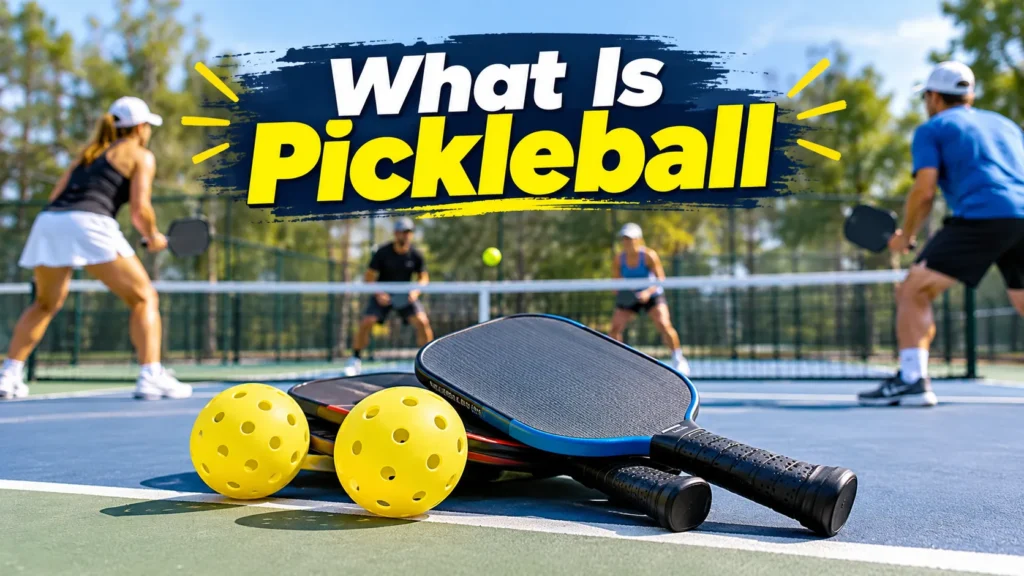
Over 36 million Americans are currently captivated by a sport that sounds like a picnic condiment yet commands the fastest-growing athletic movement nationwide. If you have ever found yourself questioning what is pickleball, you are looking at a masterclass in modern sports engineering—a high-strategy fusion of tennis, badminton, and table tennis that is completely redefining recreational culture from coast to coast.
What Is Pickleball? Core Rules & Specs
Official USA Pickleball standards (October 2026) · Compared with tennis
What Is Pickleball? The Complete Definition for New Players
So, what is pickleball at its core? It is a paddle sport played on a 20-by-44-foot court with a perforated plastic ball over a net that stands 36 inches at the sidelines and 34 inches at the center. Joel Pritchard, Bill Bell, and Barney McCallum invented it in 1965 on Bainbridge Island, Washington. Today, USA Pickleball governs the sport as its national governing body.
- Format: Matches are played as singles or doubles on the same court dimensions, so no extra lines are needed when switching formats.
- Equipment: Players use a solid, stringless paddle and a lightweight plastic ball with 26 to 40 circular holes.
- Signature Rule: The non-volley zone, known as the kitchen, is a 7-foot area on each side of the net where you cannot hit the ball out of the air.
- Skill Curve: Most beginners can rally within an afternoon, yet the game hides layers of strategy that reward patience and placement over raw power.
That contrast between easy entry and deep strategy is exactly why the sport keeps spreading through parks, gyms, and private clubs nationwide. For a deeper breakdown of every official regulation.
How a Pickleball Game Works: Serve, Score, and the Two-Bounce Rule
If you are wondering what is pickleball game play actually like, picture short, tactical rallies that build from the baseline toward the net. Every point starts with an underhand serve hit diagonally crosscourt, and that serve must clear the entire kitchen, including its line.
- The Serve: The serve uses an underhand motion with contact below the waist. The drop serve, where you let the ball bounce before hitting it, is also legal. Each server gets one attempt per rally.
- The Two-Bounce Rule: The receiving team must let the serve bounce, and the serving team must let the return bounce. After those two bounces, either team may volley.
- Scoring: Under traditional scoring, only the serving team earns points. Games go to 11, and you must win by 2. In doubles, the score is called as three numbers: serving team score, receiving team score, and server number. Some leagues use rally scoring instead.
- Common Faults: You lose the rally by hitting out of bounds, hitting into the net, volleying from the kitchen, or letting the ball bounce twice.
The two-bounce rule is the hidden engine of the sport. It removes the serve-and-volley advantage you see in tennis and forces both teams to earn their way forward to the kitchen line, where most points are ultimately decided.
What Is a Dink in Pickleball? The Shot That Controls the Kitchen
So, what is a dink in pickleball? A dink is a soft shot hit from at or near the kitchen line that arcs just over the net and lands inside your opponent’s kitchen. Its goal is not to win the point outright. Its goal is neutralization: a low ball in the kitchen cannot be volleyed, so your opponent must let it bounce and then lift it, which leaves them almost no attacking angle.
- Crosscourt Dink: This is the go-to choice for pros. It travels the longest path, crosses the lowest part of the net (34 inches in the middle versus 36 inches at the sidelines), and pulls opponents wide and off balance.
- Straight-Ahead Dink: This shorter path leaves less margin for error. Players use it mainly to break a crosscourt pattern and catch an opponent leaning the wrong way.
- Topspin Dink: It dips quickly after crossing the net, which pressures opponents to make a hurried, upward contact.
- Slice Dink: Backspin keeps the ball skidding low after the bounce, making it difficult to attack.
- Mechanics: Keep the paddle head down, hold a firm wrist, and bend your knees. Push the ball with a compact, smooth motion from the shoulder rather than a tennis-style backswing.
Dink rallies are a patience contest: the first team to pop the ball up hands the other side a putaway smash. Advanced players add attacking options such as the Erne, a legal volley taken from outside the sideline next to the kitchen. Another is the ATP (around the post), a shot that travels around the net post instead of over the net.
The Kitchen Rule: Pickleball’s Most Misunderstood Zone
The kitchen is the 7-foot non-volley zone on each side of the net, and every line bounding it counts as part of the zone. Under Section 11 of the 2026 USA Pickleball Official Rulebook, every volley must be initiated outside that zone.
- Standing In the Kitchen Is Legal: You can enter the kitchen at any time except while volleying. You can also stay inside to return a ball that has bounced.
- The Momentum Rule: If the momentum from your volley carries you into the kitchen, it is a fault. That includes your paddle, your hat, or contact with your partner. It is a fault even if the ball is already dead.
- The Re-Entry Rule: After touching the kitchen, both feet must contact the court completely outside the zone before you may volley again.
- Serve on the Line Is Short: Because the kitchen line belongs to the kitchen, a serve that touches it is a fault, unlike tennis, where a line touch counts as in.
- The Zone Is Two-Dimensional: The kitchen does not extend into the air. You may reach over the line to volley, as long as nothing touches the zone.
The momentum clause catches even advanced players. It has no time limit: it ends only once you have fully regained your balance and control outside the zone. A winning smash that slams into the back fence still loses the point if you stumble into the kitchen afterward.
Head-to-Head: Pickleball vs. Tennis
Many new players arrive from tennis, and the overlap is real: a net, a court, and doubles teamwork. Yet the two sports reward very different instincts, and comparing them side by side shows why so many converts need a few weeks to rewire their habits.
- Court Size: A pickleball court measures 20 by 44 feet, versus 36 by 78 feet for tennis doubles. A single tennis court footprint is often converted into multiple pickleball courts.
- Net Height: The pickleball net is 34 inches at center and 36 inches at the sidelines. The tennis net is 3 feet at center and 3.5 feet at the posts.
- Serve: Pickleball uses an underhand serve with one attempt. Tennis uses an overhand serve with two attempts.
- Scoring: Pickleball games run to 11, win by 2. Tennis uses 15-30-40 games inside sets.
- Equipment: A pickleball paddle is capped at 24 inches combined length and width, and 17 inches long. A tennis racket can reach 29 inches long and 12.5 inches wide. The pickleball ball is plastic and 2.87 to 2.97 inches in diameter, compared with a smaller felt tennis ball.
- Where Points Are Won: Pickleball points are won with fast hands and soft touch at the kitchen line. Tennis points are often built from the baseline with pace and depth.
The verdict: tennis rewards power and court coverage, while pickleball rewards placement, patience, and reaction speed. Former tennis players usually excel quickly, but only after shortening their backswing and learning to resist overhitting at the net.
What Is the Best Pickleball Paddle? How to Choose by Play Style
Ask what is the best pickleball paddle and the honest answer is the one whose certification, construction, and feel match how and where you play. Price alone tells you very little; understanding a few construction variables tells you almost everything.
- Certification First: Sanctioned amateur events require a paddle on the USA Pickleball approved list. The PPA Tour and Major League Pickleball require UPA-A certification. Casual recreational play accepts both.
- Core Thickness: A thicker 16mm core generally adds control and stability on dinks and resets. Thinner 13mm to 14mm cores feel crisper and deliver more pop.
- Face Material: Fiberglass tends to add power. Carbon fiber offers a stiffer feel and strong spin potential. Graphite feels light and crisp.
- Shape: Elongated paddles offer extra reach and leverage but a smaller sweet spot. Widebody shapes are more forgiving on off-center hits. No paddle may exceed 17 inches in length.
- Weight and Grip: USA Pickleball sets no weight limit. Heavier paddles add stability and drive power, while lighter models boost hand speed in fast exchanges. Pick a grip size that lets you hold a relaxed, secure grip.
The most common beginner mistake is buying the most expensive paddle on the wall instead of the one that suits their style. Start with a midweight, 16mm control paddle, then refine your choice as your strengths become clear.
Check Our Pickleball Paddle Reviews
Indoor vs. Outdoor Pickleballs: Specs That Change Your Game
Every official ball must measure 2.87 to 2.97 inches in diameter and weigh 0.78 to 0.935 ounces, with 26 to 40 circular holes. It must also bounce 30 to 34 inches when dropped from 78 inches onto granite at 70°F. Within those limits, indoor and outdoor designs behave very differently.
- Indoor Balls: Indoor balls typically have fewer, larger holes, often 26. They are softer and lighter, which makes them slower and easier to control, and rallies run longer. Over time they tend to lose their round shape.
- Outdoor Balls: Outdoor balls use up to 40 smaller holes and harder plastic. They fly faster and hold steadier in the wind. They are more likely to crack, especially in cold weather.
- Roundness Tolerance: Official balls must stay within ±0.020 inch of round, which is why a slightly egg-shaped ball should be retired immediately.
Match the ball to the surface, not to habit: an outdoor ball on a gym floor skids and speeds up, while an indoor ball outdoors gets pushed around by even a light breeze.
Paddle Durability: Core Crush, Disbonding, and Delamination
Durability has become one of the most important buying factors as thermoformed paddles take over the market. Thermoforming fuses the edges and layers under heat and pressure for power and a larger sweet spot. It also introduces failure modes that many players mix up.
- Core Crush: The honeycomb cells inside the core collapse from repeated hard hits or heat exposure, such as a paddle left in a hot car. Watch for dead spots and lost pop. Press firmly on the face with your thumb and listen for crackling.
- Disbonding: The adhesive between the face and the core fails, often in the center. The face starts acting like a drumhead and creates a “trampoline effect,” which USA Pickleball explicitly prohibits.
- True Delamination: The layers of the face material itself separate, weakening the entire structure.
- Grit Wear: Textured surfaces gradually smooth out with heavy play, so spin fades well before the paddle looks worn. Adding sand, rubber, or anti-skid paint to restore grip is banned.
Under USA Pickleball’s equipment standards, a paddle must stay compliant for its entire useful life, including after break-in. A paddle that gets “hotter” with age is technically illegal. To extend paddle life, store it at room temperature, use a cover, rotate between two paddles, and inspect the face regularly.
USA Pickleball vs. UPA-A: The 2026 Spin Rule Explained
Two certification bodies now shape the paddle market, and understanding the difference saves you from buying a paddle you cannot use in your target events.
- USA Pickleball (USAP): As the national governing body, its approval covers sanctioned amateur events. Its Equipment Evaluation Committee has tested more than 5,000 paddles and 400 balls since 2016.
- Power Cap (PBCoR): This test measures how much energy a paddle returns to the ball. The limit was set at 0.44 on November 1, 2024, and lowered to 0.43 on November 1, 2025.
- New Spin Rate Test: Since October 1, 2026, newly certified paddles must produce under 2,100 RPM, measured with a dual-camera system. This test replaces the old pass/fail roughness and friction limits. It is not retroactive.
- UPA-A: This standard governs the PPA Tour and Major League Pickleball. It adds accelerated break-in testing that simulates months of play and already enforced the same 2,100 RPM ceiling.
- Dual-Certified Paddles: Some brands certify with both bodies, so one paddle works from local leagues to pro events.
For the full technical limits on roughness, gloss, size, and prohibited features, read the official USA Pickleball Equipment Standards Manual.
What Most Pickleball Guides Miss
Most beginner guides stop at the court size and the serve. These lesser-known details separate informed players from frustrated ones.
- Certification Dates Now Matter: Two paddles can both be “USAP approved” and still have been tested under different spin rules, depending on whether they were certified before or after October 1, 2026.
- No Weight or Thickness Limits: USA Pickleball restricts paddle length and combined size, but not weight or thickness.
- Customization Has Limits: Decals and tape can extend no more than 1 inch above the grip and 0.5 inch inside the edge. Handwritten markings are allowed, but aftermarket graphics are not.
- Glare Is Regulated: Paddle faces and edge guards cannot exceed 80 gloss units, which keeps reflective surfaces from distracting opponents.
- Noise Is a Real Issue: The sharp “pop” of hard paddles has sparked complaints near homes. In response, USA Pickleball recognizes a quiet equipment category, and manufacturers use sound-dampening foam.
- Participation Numbers Vary: SFIA counted 24.3 million US players in 2025. Higher estimates come from broader surveys that count anyone who has picked up a paddle.
Knowing these details helps you buy smarter, play legally, and understand why the sport’s rules keep evolving alongside its explosive growth.
The Bottom Line
Understanding what is pickleball means looking past the funny name to a sport built on smart geometry, precise rules, and fast-evolving equipment science. Master the kitchen, learn to dink with patience, and choose a certified paddle that fits your style. Once you have those down, you will be ready to compete on any court in America.
Frequently Asked Questions
What is pickleball in simple terms?
Pickleball is a paddle sport that blends elements of tennis, badminton, and table tennis. Players use solid paddles and a perforated plastic ball on a 20-by-44-foot court. It can be played as singles or doubles.
Can you stand in the kitchen in pickleball?
Yes. You can stand in the kitchen at any time and return balls that have bounced there. The only restriction is that you cannot volley while touching the zone or its lines.
What is a dink in pickleball used for?
A dink keeps the ball low and inside your opponent’s kitchen so they cannot attack it. It is used to build pressure until the other team pops the ball up for a putaway.
Why is a serve on the kitchen line a fault?
The kitchen line is part of the kitchen. Because the serve must clear the entire non-volley zone, a serve that touches the line is ruled short.
Do I need a UPA-A paddle for recreational play?
No. UPA-A certification matters only for pro events such as the PPA Tour and Major League Pickleball. Sanctioned amateur events require USA Pickleball approval.
What is the 2,100 RPM paddle rule?
Since October 1, 2026, paddles newly certified by USA Pickleball must generate under 2,100 RPM of spin in a camera-based test. Paddles approved before that date remain on the list.
Is pickleball easier to learn than tennis?
Most players find it quicker to learn because the court is smaller, the serve is underhand, and the ball moves slower. Mastering the kitchen and soft game still takes real practice.