
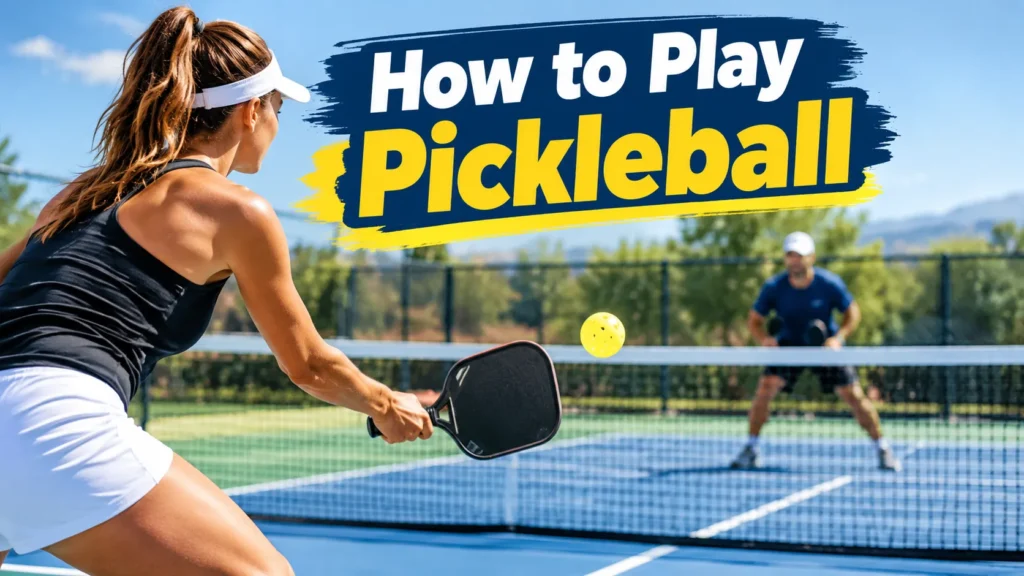
Millions of Americans are trading tennis courts for a perforated plastic ball and a composite paddle, yet stepping onto the asphalt without knowing the mechanics is a recipe for instant confusion. Mastering how to play pickleball is not merely about learning where to hit the ball; it is an exercise in tactical pacing, navigating the nuances of the kitchen, and decoding a scoring system that rewards finesse over raw power.
Whether you are prepping for your first recreational match or trying to figure out how to play pickleball singles without burning out by the second game, the secret lies in understanding foundational rules before your opponent exploits them.
How to Play Pickleball: Core Rules at a Glance
Verified against the 2026 USA Pickleball Rulebook (October 2026) · By game parameter
What Is the Objective of Pickleball?
The objective of pickleball is simple on paper: win rallies until your side reaches 11 points with a lead of at least 2. Some tournament formats play to 15 or 21, but the win-by-2 requirement never changes. What makes the game deceptive is how those points are won. Unlike tennis, where a big serve can end a point instantly, pickleball is engineered to neutralize brute force.
When Joel Pritchard and Bill Bell invented the game in 1965, they built in restrictions that keep rallies alive and make the sport playable across ages and skill levels. Three design choices define the objective in practice:
- The Underhand Serve: Every serve must be hit with an upward motion and contacted below the waist, so the server cannot overpower the receiver from the first shot.
- The Two-Bounce Rule: The serve and the return must each bounce once before anyone can volley, which delays net rushing and forces both teams to build the point.
- The Non-Volley Zone: Players cannot volley while touching the 7-foot zone next to the net, which eliminates the easy put-away smash from point-blank range.
Here is the angle most guides skip: at the recreational level, the majority of points end on an unforced error, such as a ball into the net, a ball long, or a pop-up that gets attacked. That means the real objective for a new player is not hitting winners; it is keeping the ball in play one shot longer than your opponent. Scoring format matters too. Traditional side-out scoring only awards points to the serving team, while rally scoring, used in some leagues and events, awards a point on every rally. If you want broader context on the sport’s roots and appeal, start with our overview of what pickleball is and where it came from.
How to Play Pickleball for Beginners: Serve, Bounce, and Score
Learning how to play pickleball as a beginner comes down to three mechanics you will repeat every single rally: a legal serve, respect for the bounce, and an accurate score call. Get these right and you will look like a regular on your first day.
The Serve: What Changed in 2026
- The Volley Serve: The 2026 rulebook now requires each element to be met clearly: a clear upward arc of the paddle, a paddle head clearly not above the wrist at contact, and a ball clearly no higher than the waist at contact. If it is not clear to the referee, it is a fault.
- The Drop Serve: Release the ball from your hand or paddle face and let gravity do the work, with no toss, push, or added spin. Once the ball bounces, you can hit it with any stroke, which makes this the safest serve for beginners.
- Foot Position: At least one foot must touch the ground behind the baseline, and neither foot may touch the baseline or the court. You must also stay within the imaginary extensions of the centerline and sideline.
- The Target: The serve travels diagonally and must clear the kitchen. A serve that lands on the kitchen line is a fault, while serves landing on the sideline, centerline, or baseline are good.
- One Attempt, No Lets: You get a single try per serve. Since 2021, a serve that clips the net and lands in the correct box is simply live.
The Two-Bounce Rule in Practice
After the serve bounces, the receiver returns it, and that return must also bounce before the serving team hits it. This is why servers stay near the baseline at the start of each rally, and why receivers should hit a deep return and immediately move forward. The third shot, hit by the serving team, is the most important shot in doubles because it decides whether the server can safely join the net.
Calling the Score in Doubles
- The Three-Number Call: Announce the serving team’s score, then the receiving team’s score, then the server number (1 or 2), for example “4-2-1.”
- Why 0-0-2: The team that serves first only gets one server for its opening turn, so the game starts as if the first server were already server 2.
- Switching Sides: When your team wins a point on serve, the server swaps sides with their partner and serves again. When the server loses a rally, the partner takes over, and after both have served, the serve passes to the opponents in a side out.
Your First Week on Court
- Grip: Hold the paddle like you are shaking hands with it, a continental-style grip that works for forehands, backhands, and volleys without switching.
- Ready Position: Keep the paddle up and in front of your chest between shots. Most beginner errors at the net come from a paddle hanging at the knees.
- Line Calls: You call the lines on your side, and if you are not sure, the ball is in. Under the 2026 rules, out calls must also be made promptly instead of after the rally plays out.
Read the 2026 USA Pickleball Official Rulebook
The Kitchen: Non-Volley Zone Rules That Decide Rallies
The kitchen, officially the non-volley zone, is the 7-foot area on each side of the net, and the line around it counts as part of the zone. It is the single most misunderstood area of the court, and it is where tournaments are quietly won and lost. The core rule is short, but its edge cases fill pages:
- The Core Rule: You cannot volley (hit the ball out of the air) while any part of your body, clothing, or anything you carry is touching the kitchen or its line.
- The Momentum Rule: A volley hit from a legal position is still a fault if your momentum carries you into the kitchen afterward. Timing does not save you; it is a fault even if the ball is already dead. The momentum only ends once you regain balance and control outside the zone.
- Equipment Counts: If your hat, sunglasses, or paddle falls into the kitchen as a result of your volley, it is a fault. Catching yourself by planting your paddle in the zone counts too.
- The Partner Save: In doubles, your partner may grab you or pull you back to stop your momentum, as long as your partner is not touching the kitchen.
- Re-Establishing Position: After stepping into the kitchen, you must get both feet back on the ground outside the zone before you volley. Hopping out mid-swing does not count.
- Reaching Over: Your paddle may extend over the kitchen to volley, provided your feet stay outside. Advanced players use the Erne, jumping around the corner of the zone to volley from outside the sideline.
The biggest myth is that you are not allowed in the kitchen at all. You can walk in, stand in, and hit from the kitchen whenever the ball has bounced. In fact, stepping in to handle a short dink is basic, correct footwork. The only thing banned is the volley.
How to Win the Kitchen Battle
Once all four players reach the kitchen line, rallies become a contest of soft, low shots called dinks. Aim crosscourt, where the net sits at its lowest point of 34 inches in the center, compared with 36 inches at the posts, and where you have more court to land the ball. Keep every dink below the height of the net tape on the opponent’s side. The player who gets impatient and speeds up a low ball usually loses the point, while the player who waits for a ball above the net gets to attack it.
Choosing a Pickleball Paddle: Honest Pros and Cons
The rules give you a lot of freedom when choosing a paddle. The combined length and width cannot exceed 24 inches, and the length cannot exceed 17 inches, but there is no limit on thickness or weight. That freedom is exactly why buyers get confused. Marketing claims rarely tell you what you give up, so here is a balanced breakdown.
16mm Paddles: The Control Option
- Pro, Dwell Time: The ball stays on the face slightly longer, which helps beginners place dinks and resets with confidence.
- Pro, Forgiveness: A larger, more stable sweet spot means off-center hits still go roughly where you intended.
- Con, Less Pop: Drives and serves come off slower, so players who like to attack may feel the paddle is muted.
- Con, Slower Hands: The thicker profile can feel slightly sluggish in fast exchanges at the net.
14mm Paddles: The Power Option
- Pro, Pop and Speed: A firmer response sends the ball off the face faster, which rewards aggressive drives and counterattacks.
- Pro, Maneuverability: The thinner profile moves quickly through the air during hand battles.
- Con, Smaller Margin: Soft shots are harder to control, and mishits are punished more often.
- Con, Steeper Learning Curve: New players often sail dinks and resets long until their touch develops.
Beyond Thickness: What Competitors Rarely Explain
- Shape: Elongated paddles add reach and leverage but shrink the sweet spot. Widebody shapes are more forgiving and easier to block with.
- Weight: Lighter paddles are quick but get pushed around by hard drives. Heavier paddles feel stable and powerful but are slower to react, so midweight is the safest starting point.
- Face Material: Fiberglass faces tend to feel poppy, while raw carbon fiber faces offer more grip for spin. That surface texture can wear down over many hours of play, and spin performance can drop with it.
- Tournament Legality: For sanctioned events, your paddle must appear on the USA Pickleball approved equipment list. Many low-cost recreational paddles are fine for casual play but not approved.
Neither thickness is objectively better. A 16mm paddle makes the learning phase smoother, while a 14mm paddle pays off once your soft game is reliable. Choose based on the shots you actually miss, not on what a pro uses.
How to Play Pickleball Singles Without Burning Out
Singles uses the same 20 x 44 foot court as doubles, but you defend all of it alone. That single change transforms the game from patient chess into a contest of depth, footwork, and energy management. Knowing how to play pickleball singles well starts with these principles:
- Serve Deep: A serve that lands near the baseline keeps the receiver from hitting an aggressive, angled return.
- Return and Advance: The receiver holds the edge in singles. The server must wait for the return to bounce, so hit a deep return and move to the kitchen line immediately.
- Score Parity: Serve from the right side when your score is even and from the left when it is odd. Score calls are only two numbers: your score, then your opponent’s.
- Passing Shots: With only one opponent covering 20 feet of width, drives down the sideline are more effective than soft drops.
- Energy Management: Recover to a centered position after every shot and use a split step as your opponent swings. Efficient positioning, not sprinting, is what lets you stay sharp into the second and third games.
Head to Head: Singles vs. Doubles
Put the two formats side by side and the contrast is sharp. Doubles rewards patience: four players crowd the kitchen line, rallies stretch through long dink exchanges, and the third-shot drop is the signature shot. Singles rewards initiative: open space makes drives and passing shots dominant, the returner has a built-in positional edge, and court coverage matters more than touch. Doubles is the better classroom for learning the kitchen, while singles is the better test of footwork and shot depth. Most players improve fastest by learning doubles first and adding singles once their serve and return are consistent.
Skinny Singles: The Missing Middle Step
Skinny singles uses only half the court, either down the line or crosscourt, so two players can practice doubles-style dinks and drops in a one-on-one format. It covers less ground than full singles while still building the soft game. That makes it the ideal bridge between the two formats.
Doubles Strategy Basics Every New Player Should Know
- Move Up Together: Partners should advance to the kitchen line as a unit. A team split with one player up and one back leaves an open gap in the middle.
- Master the Third-Shot Drop: A soft, arcing shot into the opponents’ kitchen buys the serving team time to move forward.
- Attack the Pop-Up: Stay patient in dink rallies and speed up only balls that rise above the net.
- Aim at the Feet: Low drives at an opponent’s feet force awkward, defensive replies.
2026 Rules Most Players Still Miss
Many guides online still describe older rulebooks. These details separate informed players from everyone else:
- No More Rally-Scoring Freeze: In rally-scoring formats, game point no longer has to be won on serve. Every rally can end the game. Traditional side-out scoring is unaffected.
- Prompt Out Calls: If you return a ball, your out call must come before your opponent hits it or before the ball becomes dead.
- Body Contact: If the ball touches your body or clothing before it bounces, you lose the rally, even if you are standing out of bounds.
- Loose Second Ball: A spare ball that falls from your pocket during a rally can now cost you the point, so leave extras off the court.
Frequently Asked Questions
Is a serve that lands on the kitchen line good?
No. The kitchen line is part of the non-volley zone, so a serve that touches it is a fault. Serves that land on the sideline, centerline, or baseline are good.
Are let serves still replayed in pickleball?
No. Since 2021, a serve that clips the net and lands in the correct service court is live and must be played.
Is there a maximum paddle thickness?
No. The rules limit paddle length and the combined length and width, but not thickness or weight. For sanctioned tournaments, the paddle must be on the USA Pickleball approved list.
Why does doubles scoring start at 0-0-2?
The first serving team gets only one server on its opening turn. Calling the server number “2” signals that the next lost rally results in a side out.
Can I stand in the kitchen during a rally?
Yes. You can enter and stay in the kitchen at any time. You just cannot volley while touching it, and you must re-establish both feet outside before your next volley.
Which side do I serve from in singles?
Serve from the right side when your score is even and from the left side when your score is odd.